Bearded dragon UVB lighting and basking temperatures, explained
The UVB tube, basking spot, cool end and night temperatures a bearded dragon needs, how far to mount the lamp, and when to replace it.
By Petaholics Team · Reptiles · · 5 min read
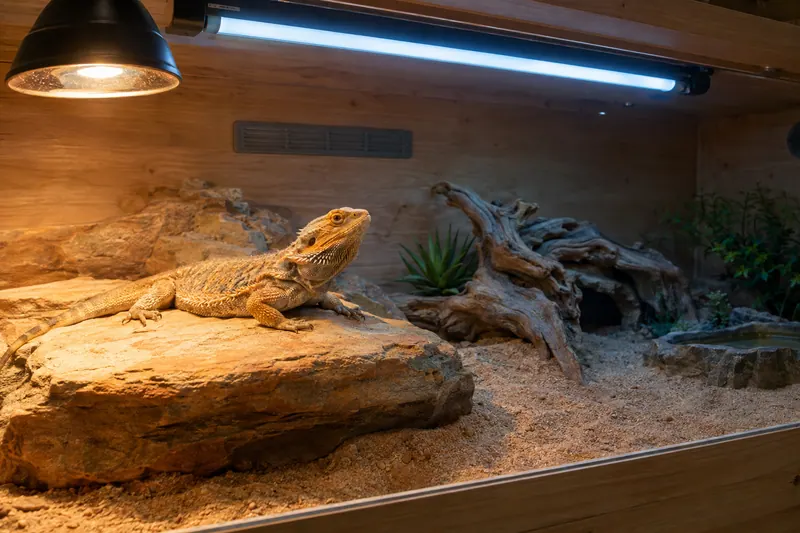
Quick answer: a bearded dragon needs a high-output UVB tube (typically a 10–12% T5) running along the warm end of the enclosure, plus a separate basking lamp that creates a hot spot of around 38–42°C (100–108°F) with a cooler end of 22–26°C (72–79°F). Lights should be on for about 12 hours a day and off at night. These figures come from the RSPCA bearded dragon care sheet, produced with lighting specialists. Measure both heat and UVB yourself rather than relying on the box.
Why bearded dragons need UVB
In the wild, bearded dragons bask in strong Australian sunshine. UVB light lets their skin make vitamin D3, which they need to absorb calcium. Without enough UVB, a bearded dragon can develop metabolic bone disease (MBD), which weakens bones and causes deformities, fractures and tremors. The RSPCA notes that a lack of UVB is the most common cause of MBD in pet reptiles.
Window glass blocks most UVB, so sitting by a sunny window doesn't count.
Choosing a UVB lamp
There are three main types:
- T5 high-output (HO) tubes. The most popular choice. They give a strong, even spread of UVB over the basking area. A 10–12% tube is typical for bearded dragons.
- T8 tubes. Older and weaker than T5. They need to be closer to the animal and are generally a less effective option for bearded dragons.
- Mercury vapour bulbs. Combine heat, light and UVB in one bulb. They can work well in large enclosures but are harder to set up correctly.
Compact or coil UVB bulbs produce UVB over only a small area and are generally not recommended as the main UVB source for bearded dragons.
How long should the tube be?
The RSPCA suggests a tube of up to about half the length of the enclosure, mounted towards the hot end with a reflector. This creates a gradient: strong UVB in the basking area and very little in the shaded, cooler end, so your dragon can choose how much exposure it gets.
Getting the UVB strength right
UVB strength is measured as a UV Index (UVI). The RSPCA recommends a UVI of about 3–5 at the basking spot, falling to zero in the shade. Some specialist keepers aim slightly higher at the basking spot.
You may also see bearded dragons described as "Ferguson Zone 3". That's a broad category describing the average UV exposure for the species across its whole day, not the peak at the basking spot, so don't use it as your basking target.
Distance and mesh
UVB drops off quickly with distance. Mounting the lamp above a mesh lid also blocks a significant share of the UVB, often roughly a third to a half depending on the mesh. Follow the lamp manufacturer's distance guidance, and the only reliable way to know what reaches your dragon is to measure it with a UV index meter (such as a Solarmeter 6.5) at the basking spot.
Basking and cool-end temperatures
Bearded dragons control their body temperature by moving between hot and cool areas, so the enclosure needs a gradient:
| Area | RSPCA guidance |
|---|---|
| Basking spot (hot end) | 38–42°C (100–108°F) |
| Cool end | 22–26°C (72–79°F) |
| Night | No lower than about 20–22°C (68–72°F) |
Some care guides quote a slightly higher basking surface temperature. What matters most is that your dragon has a real choice between hot and cool.
Practical tips:
- Use a basking lamp (a halogen flood is popular) over a flat rock or platform. The RSPCA suggests the dragon's back should be about 25–30 cm from the heat lamp.
- Control heat lamps with a thermostat and fit lamp guards to prevent burns.
- Measure surface temperatures with a digital probe or infrared thermometer.
- Turn all lights off at night. Most homes stay warm enough; if yours drops below the night range, use a heat source that gives off no light, such as a ceramic heater on a thermostat.
Lighting schedule
Run lights for about 12 hours on and 12 hours off. A plug-in timer makes this easy and consistent.
When to replace the UVB lamp
UVB output fades long before the visible light does, so a lamp can look fine but provide little UVB. As a rough guide:
- T5 HO tubes: about every 12 months
- T8 tubes: about every 6 months
- Mercury vapour bulbs: about every 8–12 months
Always follow the manufacturer's recommendation, write the installation date on the fitting, and check output with a UVI meter if you have one.
Enclosure size
Lighting works best in a properly sized home. The RSPCA recommends a minimum enclosure of about 120 × 60 × 60 cm (4 × 2 × 2 ft) for an adult bearded dragon, which leaves enough room for a real heat and UVB gradient.
Signs of a lighting problem
Speak to a reptile vet if your dragon shows:
- Lethargy, or not basking or eating
- Swollen or soft jaw or limbs
- Twitching, tremors or difficulty walking
These can be early signs of metabolic bone disease or other health problems.
Frequently asked questions
Does UVB go through glass?
Ordinary glass and most plastics block most UVB, so the lamp must shine directly into the enclosure or through mesh.
How far should a UVB light be from a bearded dragon?
It depends on the lamp's strength and whether it's above mesh. Follow the manufacturer's guidance, then measure the UVI at the basking spot and adjust the basking platform height.
Do bearded dragons need light at night?
No. They need darkness at night. If extra heat is needed, use a heater that gives off no light.
Can a bearded dragon get too much UVB?
Yes. That's why the enclosure needs a gradient with shaded areas, so your dragon can move away from strong UVB.
This article is general guidance and not a substitute for advice from a reptile vet.